Showing posts with label DSLR. Show all posts

Thursday, 15 September 2011

Are DSLR's becoming an endangered species?

Not many people use a 35mm film camera any more. Even less a medium format one. When was the last time you saw a photographer with a tripod in front of them and a cloth over their head?

The majority of cameras used and sold are small and light. Most are compact cameras, but more and more are m4/3, NEX, NX and the like. Great image quality, of that there is no doubt, but threatening the DSLR? well maybe not yet.

Why? 

The marriage of large(r) sensor and compact camera is unfortunately being dominated by the compact camera half at the moment. This may change with the NEX-7, but currently manufacturers seem to be rushing towards ever increasing (decreasing?) miniturisation. The point of a DSLR isn't just its sensor size and image quality, but the construction of a picture taking machine that makes it possible to take pictures in difficult situations, with reliability, precision and speed. A good DSLR is a responsive intuitive machine which lets us as photographers do what we do with ease, and frees us up to concentrate on what we do best, create images.

I'm as enthusiastic as anybody else about the possibilities that these small(er) cameras can bring. But what I see so far is just that. Possibilities. 

A lot of what you you read here is discussion/tests/reviews etc. of mainly these small, light cameras and I do enjoy using them. But whenever I simply have to get the picture, and I'm in any kind of pressured situation, out comes the Nikon D7000. If I'm working indoors, and undertaking any kind of commercial work, out comes the D7000 again. 

Is the future of m4/3 and CSC's as the providers of cameras for the "enthusiast" the "advanced amateur" or the "hobbyist" and for "professionals" to have a bit of light relief with? Or is somebody on the verge of giving us something serious and yet seriously small?

Sony might have it ready and waiting. Fuji claimed they had it with the X100, but unfortunately though they made a nice camera, it wasn't the game changer that many of us want.

35mm was treated as a joke for many years and yet became the mainstay of many photographers and it is very early days in the development of CSC's, but I do hope that this potential doesn't disappear under a mountain of gadget driven plastic. I'd be very happy to put my D7000 on ebay but thats not something I'm contemplating anytime soon.

Wednesday, 31 August 2011

There's still something "reassuring" about a DSLR

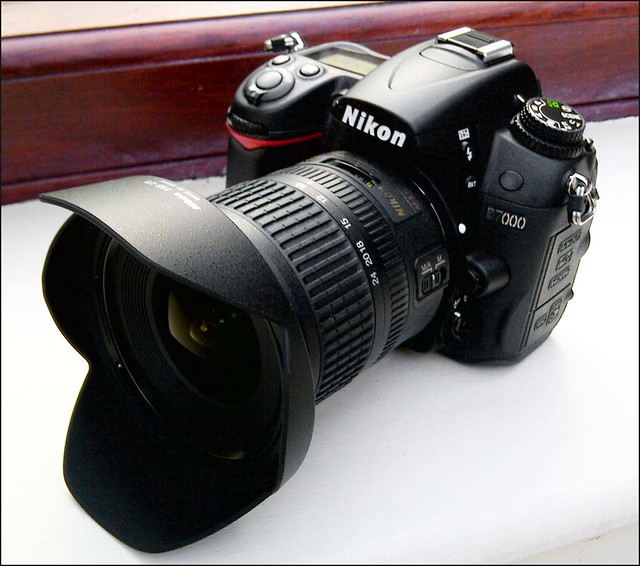
Nikon D7000 10-24mm Zoom

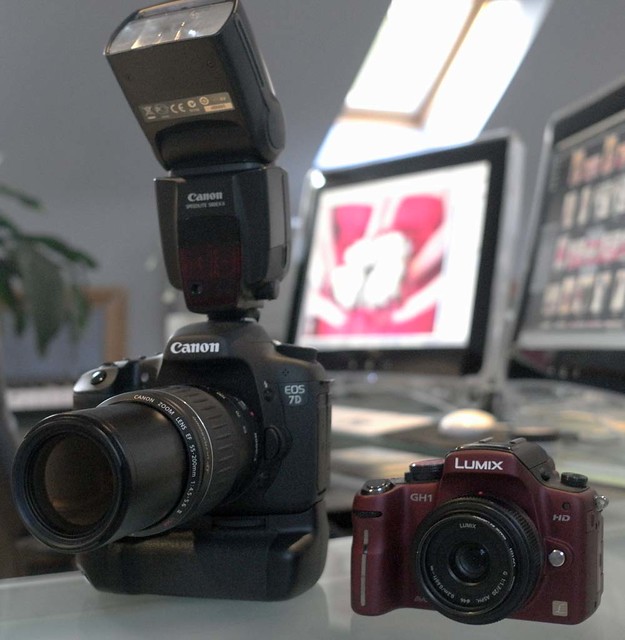
I like small cameras. Anyone who has read anything of what I've written here over the last three years or so will realise that. However in all that time there has only been a very short period when I haven't had a DSLR at the same time. Though I have issues about the weight of them, in general, I've never stopped enjoying the feeling of picking one up and shooting pictures with it. Male macho posturing probably, but there is a certain satisfaction in holding a large black DSLR + battery grip + big lens. I will admit to a certain sense of "Look what I got, its big isn't it?"

Canon 7D Panasonic GH1

This "mines bigger than yours" attitude is obviously nothing to do with photographic ability, but are we all immune to it? If we are out with our m4/3 camera or CSC, and we walk past a photographer carrying some huge Nikon or Canon rig, how many of us have that little voice inside saying "I wish I'd bought the DSLR,  he/she looks like a "proper" photographer and I don't." Note I used he/she. The common consensus is that this is a male thing. However recently I've seen a fair number of female photographers using large DSLR outfits. It may have been my imagination, but did I detect the merest hint of "Check out my camera" on their faces?

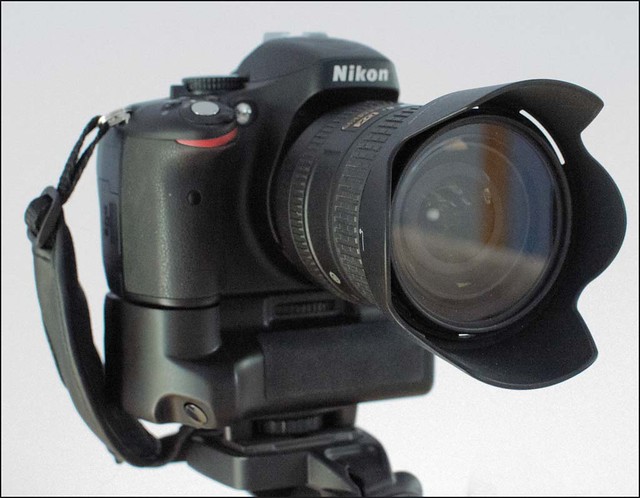
Nikon D5100 16-85mm zoom photographed with a Nikon D7000 and 35mm f/1.8 lens.

So what exactly does a DSLR give me? There's certainly a sense of reliability, solidity and the ability to "get the job done". Whether this has any basis in reality, is another matter. Certainly the only cameras I've ever had fail on me have all been DSLR's, so maybe that impression is not that realistic.

There is also the sense that it's saying "I'm a photographer, thats what I do" with the added implications that, "I'm not a snapshooter"  "I'm serious about photography" "I create images I don't take pictures" No matter what we tell ourselves, are those thoughts and the fact that we want to be taken seriously, lurking in our minds?. I'm honest enough to admit that these thoughts do surface with me from time to time.

So why do we need this "reassurance?" Why this constant desire to prevent the pain of "Camera envy?"  Maybe it's something to do with the fact that, in the "developed" world at least, photography and camera ownership is pretty universal. How many people do you know who haven't got some device for taking pictures? Is there then a sense of setting ourselves apart from the crowd, placing ourselves on a higher level from the masses and the snapshooters? And does a DSLR do that better than a smaller camera, no matter how good that may be?

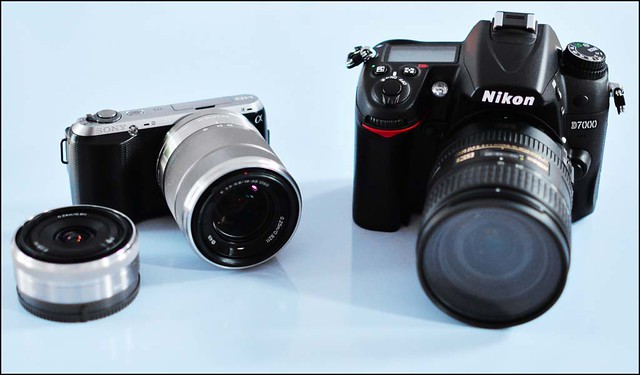
Sony NEX-C3 17-55mm 16mm f/2.8 Nikon D7000 16-85mm

The one on the left has virtually the same sensor as the one on the right. Look at the pictures they create side by side and you won't tell the difference. But which one says "I'm a photographer" ?

I enjoy using my Nikons, I know that the NEX-C3 will give me the same quality for 95% of the picures I take (sorry - images I create!) but I still like using them. I know my Leica M9 will give me sharper, "better" images, but I still like using the D7000. I like the instant feel of the shutter. I like the fact that it feels solid and substantial in my hand. I like the feeling that there's all that speed, power and functionality just waiting for me to unleash it. I like it because it "feels like a camera, godammit!!"

All of this may be completely irrational and yes, its not what photography is about, but if this is what we feel, why not admit it and indeed embrace it. If we feel good about the camera we are using, and the camera we use makes us feel better about ourselves as photographers, then it just might help us to take "better" pictures. Because if we feel like a "real" photographer because of the camera we use, then don't we have to go out and prove it?


Tuesday, 19 July 2011

Nikon jpgs - Workflow - "Death of the DSLR"

Nikon D5100 16-85mm lens
Nikon D5100 16-85mm

Having been editing the images from my Devon trip over the past few days, I've been noticing just how good the out of camera jpgs. are from both the D5100 and D7000.  In terms of sharpness I can still get a better result from a raw file conversion, but the Nikon jpgs. are completely free of any Chomatic Abberation and fringing, indicating that this is being removed in camera.

Nikon D5100 16-85mm lens
Nikon D5100 16-85mm

Panasonic, for example, have always been criticised for making in-camera "corrections" to their lenses, but as I've written time and time again, they are not the only camera manufacturer to do this.

I've never thought that there's anything wrong with this, the end result being the most important thing.

Nikon D7000 55-300mm lens

In terms of saving me time, and making my workflow go quicker, this is very useful. As I said the jpgs. aren't quite as sharp as the raw conversions I can get with ACR, but this can be dealt with in Photoshop. 

One thing I've been noticing lately is the very high acceptance rate I've been getting, from the picture libraries that I submit to, with both the D5100 and D7000 files. Its very much the case that CA and fringing are the main reasons for picture library rejection of images. Being able to submit files without either of those is obviously an advantage to me. While I prefer to work with raw files, I am prepared to take advantage of this time saving.

In terms of sharpness, picture library assessors aren't looking for biting sharpness, in fact Getty Images ask for files that are unsharpened and in the past have recommended that images when viewed at 100% should be "slightly soft". This is to allow sharpening to be added for reproduction. As I've indicated before I do sharpen all the images I send out, but the point is that libraries and stock agencies are more concerned with other things than the sharpness of a file.

Nikon D5100 16-85mm lens
Nikon D5100 16-85mm

All of this is making me warm towards the Nikons even more. While I love looking at the images I create with the Leica M9, they are harder to get "right" for the libraries I submit to. I've written a lot about the need to remove the dust spots (again the Nikon images are refreshingly free of this) and in addition to this each file has to be checked for moire, CA and fringing. There is a myth that M-mount lenses and Leica lenses in particular don't exhibit CA and fringing. Well, its just that, a myth!

So both these Nikon cameras are not only fast in operation, but are proving to produce files that are very easy and quick to process. Add in the results I got with my D7000 > Leica M9 test the other day - http://soundimageplus.blogspot.com/2011/07/just-how-good-is-nikon-d7000-image.html - and they are proving to be a good investment.

Nikon D7000 10-24mm lens
Nikon D7000 10-22mm lens

All of this is making the predictions of the death of the DSLR somewhat premature. I've always thought that the idea they would "disappear" has no real basis in fact or reality. As long as they deliver the goods, people will buy them. Manufacturers now seem to have got the message that the smaller and lighter they are the more many of us will like them, so many of the criticisms I have had about big chunky DSLR's are being adressed. 

The D5100 is very small and light and I can see this trend continuing. 

Lenses are trickier. In order to cover an APS-C sensor, the size advantages of m4/3 are more difficult to achieve, though in terms of primes its perfectly possible to make very small lenses such as the Pentax limited series. Zooms are more difficult. Indeed some m4/3 examples aren't exactly small.

You only have to look at the Sony NEX system with its large lenses on small bodies, to see that there are some problems to be solved yet. Modern construction methods will give us lighter lenses but the small superzoom is probably still some way off. 

Wile mirrorless and compact system cameras have their advantages, they are not as yet the complete answer. Also as far as I'm concerned, the quest for ever more miniturisation is pushing me away from them rather than drawing me in more. There is a limit to how small a camera can be made to make it useable, and as far as I'm concerned that limit has been reached already with cameras such as the GF3. 

To be honest I can see people still predicting the "Death of the DSLR" in 20 years time. True it probably won't look the same as it does now but things move much slower than is often predicted. There continues to be a very strong market for DSLR's and the major players in that market, Nikon and Canon, aren't going to sit on their hands. They will be looking at the success of the CSC's and incorporating those ideas into their future cameras, of that I have no doubt.


Finally two anecdotes. They prove nothing but I thought I'd include them anyway.

I was buying a laptop from the Apple Store and having told the assistant I was a photographer, then got into a discussion about photography and cameras. He told me that he and many of his colleagues in the store, average age about 21-22 I would guess, were keen photographers. He said they all used DSLR's, mostly Canons. "What about the iPhone? Do you use that? I asked" "No, we're serious about photography" he replied.

On my last visit to Jessops, the largest photographic retail group in the UK,  I was served by an even younger assistant, around 17 or 18 I guess. Jessops sometimes employ people whose photographic knowledge is a little basic, to say the least, but not so in this case. I was looking at a Panasonic G3 at the time, and while chatting away the assistant told me that he was a keen photographer, but again used a DSLR as he thought the CSC's were too small and he had trouble using them. He also liked his DSLR's (a Sony) speed and overall performance. He also admitted that he liked using a DSLR because he thought it looked much more like a "proper" camera.

As I said, this proves nothing, but it goes along with the fact that in all the time I've been photographing in recent years, often in holiday and tourist spots, I have only ever seen one other person using a m4/3 camera. Compacts and camera phones by the thousands and lots and lots of DSLR's. The last photo show I went to was virtually 100% DSLR users with just me carrying a GF1. The Nikon stand was 5 deep, and virtually no-one was on the Panasonic stand. The latest model in the Canon 550D / 600D series usually outsells the entire CSC range, just by itself, so the DSLR probably has some mileage left in it yet. If they keep on making them as well as the D7000 and D5100 then I'm certainly not going to complain.



Saturday, 12 June 2010

SCS


Reprinted by kind permission of:-
The University of Worcestershire, Department of Irrelevant Yet Lucrative Studies.
Excerpts from the Paper "Illnesses associated with Photography" by Justin Cash and R.U.Serious, Senior Lecturers in Psychosomatic Media Disorders ©2009

S.C.S or Small Camera Syndrome is an obsession with small cameras. Sufferers from this condition develop an uncontrollable desire to sell their cumbersome, oversized and overcomplicated DSLR's (invariably black) and replace them with ever smaller and lighter alternatives. Dr. Hans Full (Ph.D, C.A, I.Q) of Solms University identified this pattern of behaviour in the 1930's. He saw it as an irrational desire to enjoy photography, without the need to carry large quantities of equipment in ever expanding camera bags.

Many of those afflicted with the disease group together in small, semi-religious sects on the internet. Long-term sufferers promote therapeutic alternatives via a network of self-help organisations such as Rangefinders Anonymous and Photographies Sans Douleurs Dorsales.

Many have tried to explain this. Dr. M. Oron of the MCS (Macho Camera Society) in his paper MInes bigger than yours (2009) said "While the disease is understandable for women and children, it is particularly disturbing for men. They seem to loose their masculinity by rejecting the norms of photographic society and in seeking to return to a simpler, less complicated way of taking pictures, put themselves into conflict with their peers."

The I.I.G.M.K.I.B (If its got more knobs its better) group, have taken an aggressive stance towards those who state that S.C.S is not in fact an illness, but an enlightened way of dealing with the complex issues of camera kit. In their recent publications, Flak Jackets and Telephotos and Big lenses: More fun than a Gun! They have aroused controversy by promoting the view that sufferers of S.C.S are actually a subversive organisation seeking to erode the long established traditions of photographic equipment purchasing. Their car bumper stickers proclaiming "Stand back! I've got a 300MM f2.8 and I'm going to use it!" have given rise to protest demonstrations in many towns and cities.

P. Sonic and Sam Sung authors of Pictures from my Pocket and Small is Special have taken the line that S.C.S is actually a healthy and desirable development. "In seeking to distance themselves from the ontological zeitgeist of the DSLR proliferation of recent years, so called S.C.S sufferers are merely responding to the negative discombobulation and persnicketiness (sic) of self-describing real photographers and offer a quasi-theological solution to this dilemma based on a reaction to the tautological imperatives promoted by those who in their struggle for consumerist producerism domination, merely encourage a guerilla type reverse proportionality response to the problem. In opposition to those who erroneously justify their error by misquoting the works of Marshall Mcluhan, which, as should be obvious, is an absurdly inappropriate understanding of this argument, we assert that SCS, far from being an illness, is a mature and innovative response to the non-ethical yet persuasive dominant mores prevalent in todays aquisition led society ."

The N.C.F.M.A.I.S (National Centre for meaningless and irrelevant statistics) have identified S.C.S as being on the increase. From a small but consistent population of sufferers, prior to 2009, the occurrence of the syndrome has risen dramatically in the last two years. Many see this as a direct consequence of easy to obtain products flooding in from manufacturers in the far east. Despite the efforts of organisations such as B.C.R International (Big Cameras Rule) and P.W.O.C.A.N.A.T.O.R.P (People who own Canons or Nikons are the only real photographers) to point out the dangers of these imports, including the notorious pink hybrid, more and more photographers are becoming addicted to these products.


References
1. Dr. Hans Full (1932-02-01) Small Camera Syndrome
2. Dr. M. Oron (2009-11-07). Mines bigger than yours
3. I.I.G.M.K.I.B group (2009-11-16). Flak Jackets and Telephotos. Big lenses: More fun than a Gun!
4. P. Sonic and Sam Sung (2009-08-08) Pictures from my Pocket. Small is Special.
5. N.C.F.M.A.I.S (2009-12-10). Analysis of Diseases related to Camera Purchasing. 2008-2009.
6. P.W.O.C.A.N.A.T.O.R.P (2009-11-21). Small Cameras Suck.