Showing posts with label m4/3. Show all posts

Monday, 23 January 2012

The continuing appeal of m4/3 (A moderately serious post)

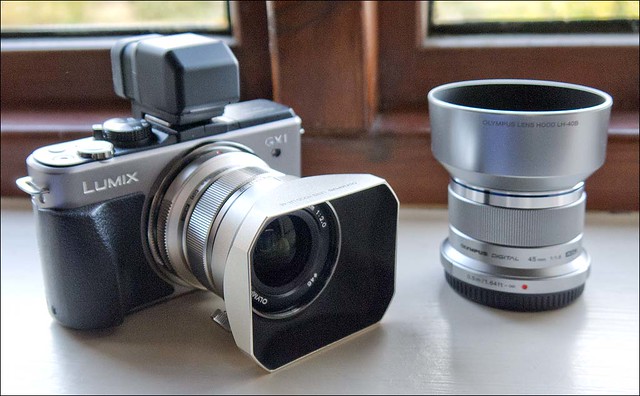
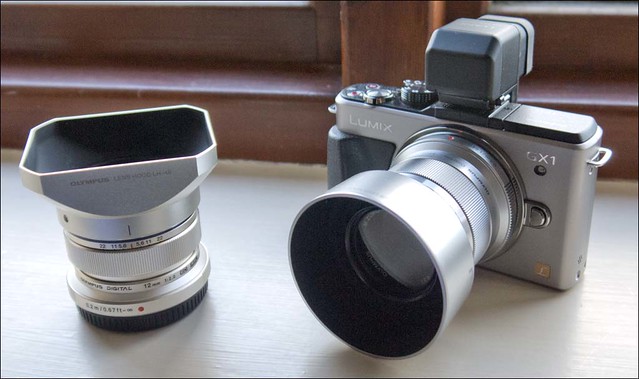
Panasonic GX1 Olympus 12mm f/2 45mm f/1.8 lenses
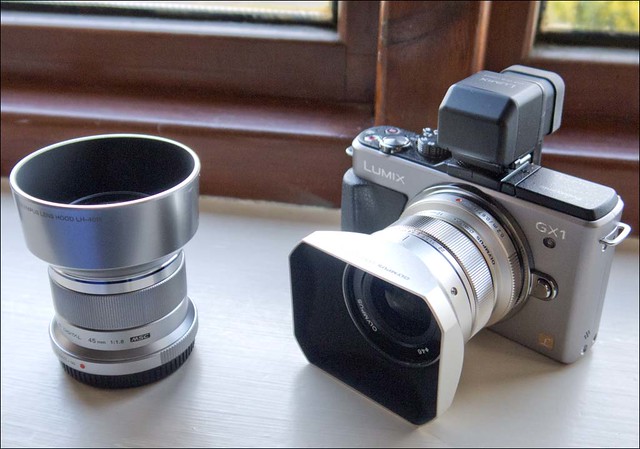

Panasonic GX1 Olympus 12mm f/2 45mm f/1.8 lenses

Cute aren't they! Despite all my adventures with the Sony NEX system and my liking for the handling, design and file quality, I'm still very attracted to the m4/3 system. Its actually quite difficult to explain why, but despite everything else I use, I keep coming back to it.

I think its a combination of many different things, none of which makes the system "better" for me, but which put together means that I enjoy using it and the pictures it produces. I should, I suppose, be using my NEX-7 all the time, as it produces the biggest files, and there's no doubt that its a more well-featured camera than anything that m4/3 has come up with so far, but I still need my m4/3 fix every now and then. 

So whats the appeal?
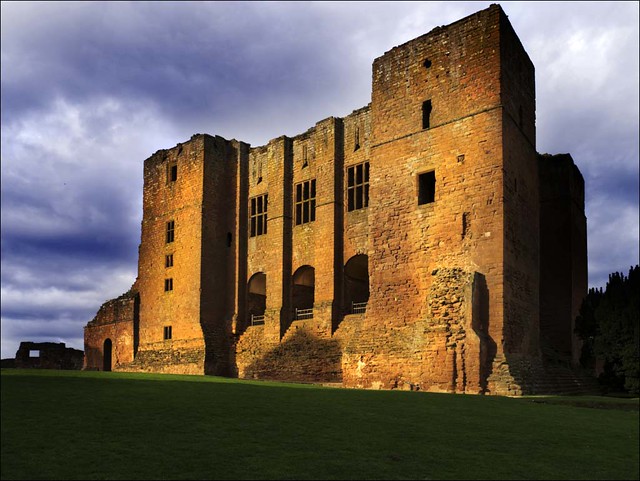
Panasonic GX1 Olympus 12mm f/2

The 4:3 ratio is something I like. As can be seen from all the Pentax 645 film scans I'm posting, its a format I like and have used for many years.

The depth of field advantage is very useful for someone who shoots travel/landscape and architecture. I very rarely use differential focus, and generally need my images to all be in sharp focus. Using the Olympus 12mm, for example, means that I can happily use f/4 and f/5.6, knowing that I will be getting similar DOF results to using a 24mm lens at f/8 or f/11 on a 35mm / FF system. This allows me to use faster shutter speeds when I'm hand holding resulting in sharper images. This was a tremendous advantage yesterday when I was shooting these castle images, as I was working in a gale, and was almost blown off my feet a few times. Without being able to use wide apertures and fast shutter speeds I would have had real trouble getting sharp pictures.

I obviously appreciate the size and weight advantages, and there is no doubt that the system has the best balance between between lens and bodies of all the CSC systems. It also has by far the most comprehensive lens range.
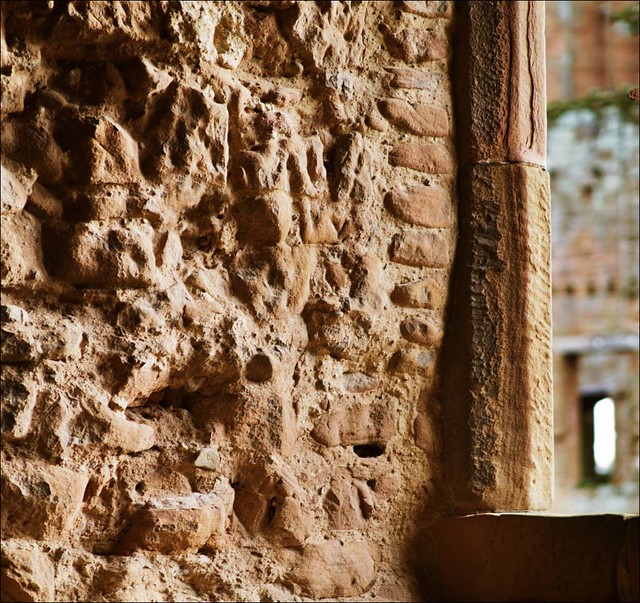
Panasonic GX1 Olympus 45mm f/1.8 lens
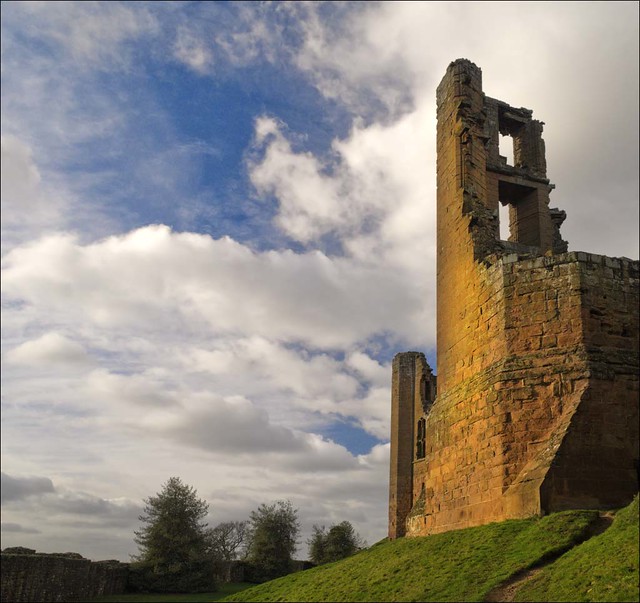

Panasonic GX1 Olympus 12mm f/2
Panasonic GX1 Olympus 45mm f/1.8 lens + Polarising filter

There's also no doubt that at low ISO's the Panasonic m4/3 sensors produce very high quality files. I've learnt to deal with the luminance noise that the 16MP sensor produces even at base ISO, and I've always liked the colour and overall look of the images. Plus the fact that the sensor seems to use a lighter anti-aliasing / low pass filter than the NEX system makes the images look sharper on the screen.
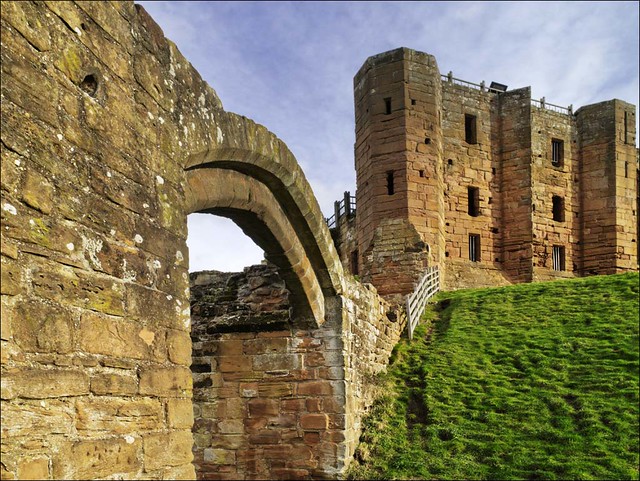
Panasonic GX1 Olympus 12mm f/2
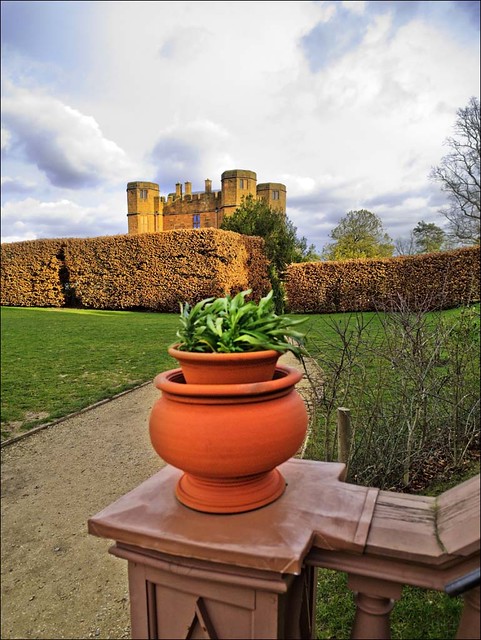
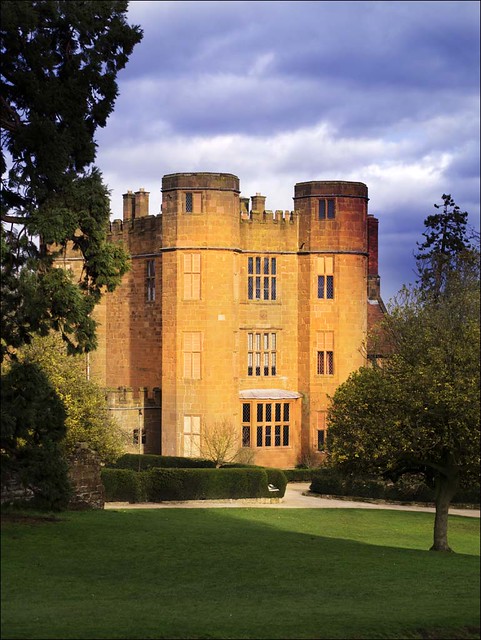
Panasonic GX1 Olympus 12mm f/2

Panasonic GX1 Olympus 45mm f/1.8 lens
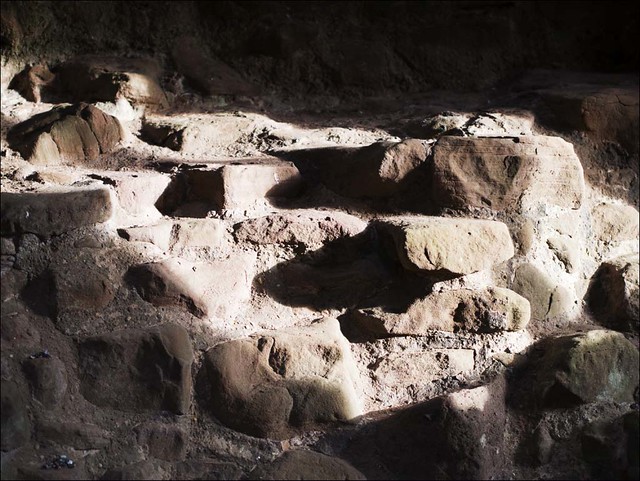

Panasonic GX1 Olympus 45mm f/1.8 lens

And then of course there are the aesthetics of the camera and lenses themselves.

Late last year I was becoming heavily involved with the NEX-5n, and was using it virtually exclusively. However, I still couldn't resist the GX1. My long standing love / hate relationship with the Olympus Pens has been well documented here and just when I thought I'd got the Japanese corporate answer to the Sopranos out of my system, they have to go and come up with this.


 OK, I know this is a fake, but its not going to look radically different to this.

Olympus sure know how to push my buttons. These are my favourite camera designs of all time.


The small SLR design with a pentaprism and a silver / black colour scheme makes me go weak at the knees, always has. It may have something to do with the fact the my first "serious" camera was the Pentax ME Super, pictured above, but I've been waiting for a decent equivalent of this for ages. It looks that Olympus are about to do just that with their heavily leaked OM-D. Not only have they seduced me with the look, but they have finally (FINALLY!) decided to use a bigger sensor and have also decided to make it a more robust, weather-sealed body. I guess the 12-50mm weather-sealed lens was a pretty heavy clue that a comparable body was arriving, since what use is a sealed lens without a sealed body. 

There is no way I will be able to resist this, no way I won't have my name down for a pre-order the moment I'm able to do that and no way, I fear, that I won't probably love it to bits and use it despite all its shortcomings, which being an Olympus it will probably have.

If I wasn't taking pictures for a living, I would be using an E-P3 exclusively. I wouldn't care that the images a bit "grainy" at low ISO's, that its got a sluggish shutter button, which tends to make the lighting fast AF a bit redundant, that its got a "peculiar" menu system and that its only 12MP. Despite all my reservations, I loved using it. Its a miracle I managed to sell it, since I tried several times putting it on ebay and then always took it off again. I was about to do the same last time, when someone inconveniently bought it!!

However now I have the OM-D to dream about. I just can't help myself. Of all the cameras announced over the past few years, this is the one that has excited me most. It won't have the best image quality, it won't have the best handling, but if its anything like I think its going to be, it will sure look gorgeous. 

Olympus, I hate you! (But I love your cameras)
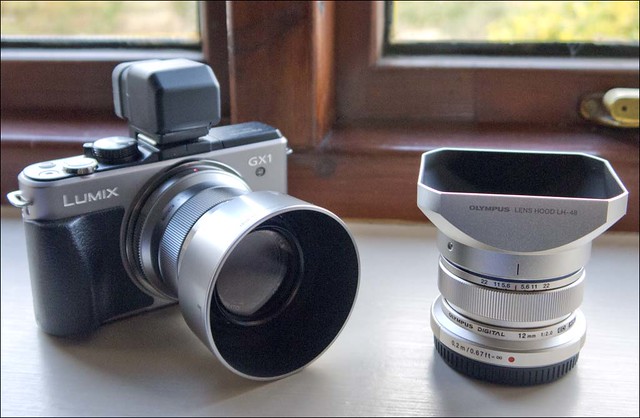
Panasonic GX1 Olympus 12mm f/2 45mm f/1.8 lenses

Panasonic GX1 Olympus 12mm f/2 45mm f/1.8 lenses

Thursday, 3 November 2011

So how did I end up with this? And keep going on about how good it is. And why did I sell the Leica M9 and my Nikons?? - Part 2

Sony NEX-5n 16mm, 30mm, 18-55mm, 55-210mm and 18-200mm lenses

Continuing the story of my latest gear "rationalisation". 

The Nikons went when I got the a77. Nothing wrong with either the D7000 or D5100, but again its a megapixel advantage. Whether or not the Nikons produce better images, or are better cameras, is in many ways immaterial. In my line of work the more MP's the better. It means I can sell images for higher fees, the people who buy them can use them at larger sizes or crop them.

The raging debates on the merits of one camera system versus another on forums are basically splitting hairs. The websites who sell my work like more MP's, the people who buy my pictures like more MP's. With the a77 I can provide these. It happens to be a very good camera and the image quality is excellent, but it has to be said, even if the pictures it produced were inferior to the D7000 (and at everything bar high ISO they aren't) they would still be more commercial because of the higher pixel count.

If I was a sports or news photographer, other things would come into the decision of what camera to use. How fast and resposive is it? Does it have a wide lens choice? Is it good in low light? When these considerations are taken into account, a camera like the D3S with its 12MP sensor is the camera of choice for many. However since I shoot landscape, location and travel shots, my needs are different, and the a77 is perfect for me.

The main reason for all this changing around is something else though. It also revolves around a camera that I don't even have yet. The Sony NEX-7. 

As soon as this was announced, it seemed the perfect camera for me. I often talk about how I can manage cameras like the D7000 and they are not that heavy. But in reality I do have real problems. At the end of my last big 10-day trip, I was having to lie flat out on the ground to let my back recover, every half hour. This as a result of hauling a Nikon + zoom lenses around. I write all the time about about how weight is much more important to me than size. I'm an outdoors photographer and what I take pictures of involves a lot of walking. So I have to carry everything with me. Doing this day after day has repercussions and I've been doing this now for over 20 years, so there's a fair amount of wear and tear on my back muscles. I'm glad to say that my stamina and fitness are holding up but many of the muscles I use to carry this gear and shoot with, have taken to complaining quite vigorously.

So the NEX-7 looked (and still does) a godsend. A light small camera, with a huge sensor. It is still my plan to get one at the first available opportunity. Since it shares a sensor with the a77, I've had a good opportunity to assess that, and I'm very pleased with it. I've also taken the opportunity to look at the OLED viewfinder in both the a77 and NEX-5n and I'm very happy with that also. So unless there is some significant other problem with the NEX-7, I've basically done the research and the camera should be just what I'm looking for.

Along the way I've been impressed by the a77 and am planning to keep that for all those situations when I need a DSLR (lookalike!) and I've also been very impressed by the NEX-5n, with regard to its overall handling, image quality and high ISO performance. It therefore strikes me that it makes sense to go with these three cameras, add in the new SLT adapter so that I can use a-mount lenses to fill in any gaps in the NEX system (and there are quite a few) all of which gives me an integrated system and one that I think will provide me with the best compromise between useability, portability and image quality that I can achieve with whats available currently.

It also frees up some of my equipment budget and means that I don't have so much money tied up in very expensive systems such as Leica and Nikon.

So where does this leave my m4/3 gear?

I tried writing a piece on this a few days ago and I got such a heated and in some cases, downright nasty, response that I ended up removing the posts and the comments. However I am going to discuss this again, but in order to prevent a re-occurance of what happened previously, I've disabled commenting on this post.

Micro Four Thirds has served me well, in fact it has been my main system of choice for the past 2-3 years. Not so much in recent months however, for reasons I will come on to. 

Its been light, portable and provided me with the quality I need. Its been a bit short on the megapixel front, but I've got round that by shooting stitched multi-image panoramas. There are also some superb lenses available. However things move on, and I get the impression, rightly or wrongly, that the development of the system is somewhat stalled. Stalled in the amount of pixels that they are able to get on the 4/3 sensor and stalled in the way that every new model that is introduced seems to be only a marginal improvement on the previous one. I also get the feeling that I'm now some distance away from who they are targeting these cameras at. I've written enough times about how I dislike the ever decreasing size. A GF3 with a pancake lens may be a miracle of engineering and take really good pictures, but without a viewfinder (and the current Panasonic one is mediocre at best) I find something like that really uncomfortable and difficult to use.

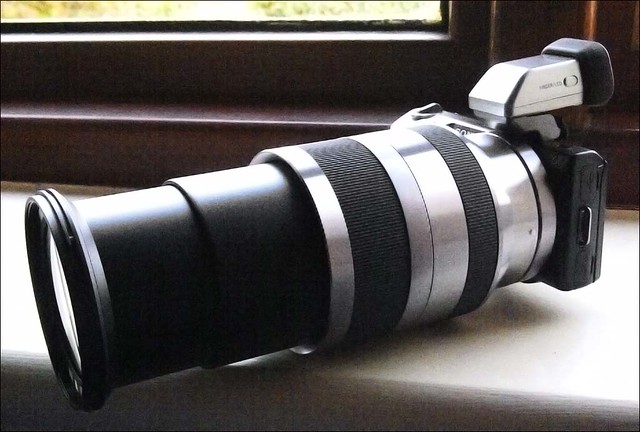
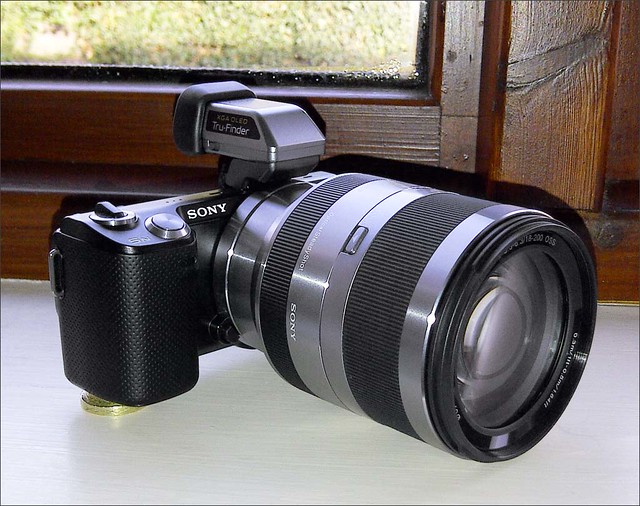
It could be argued that the Sony NEX-5n is even smaller, but when the viewfinder is added and a NEX lens fitted, it suddenly turns into something else for me. There are lots of complaints about the size of the NEX lenses, but I like the fact they are bigger. My 5n with the 18-200mm fitted feels great to me. Because of the way I hold a camera and because of what I'm used to I feel very comfortable with this. Yes it looks all wrong, but looks aren't everything.

Sony NEX-5N 18-200mm

Sony NEX-5N 18-200mm

And of course for the bulk of my work, this is all I need. I shoot in good light outdoors, with low ISO's for the vast majority of my work. Substitute the NEX-7 for the 5n and that will be my workhorse. And if it starts to get a bit heavy I've got alternatives. The 30mm and 55-210mm outfit I used the other day is very light, and for the first time in a long time I finished my shoot with no back pain. Then there's the ultra-light 16mm and the upcoming Zeiss 24mm and 50mm lenses. Again neither of those is very heavy.

So it seems that I may well be moving away from m4/3. Its been happening gradually over a period of time anyway. I didn't even take any of my m4/3 gear with me for my recent trip, preferring to use the Leica and my Nikons.

There is one problem though!

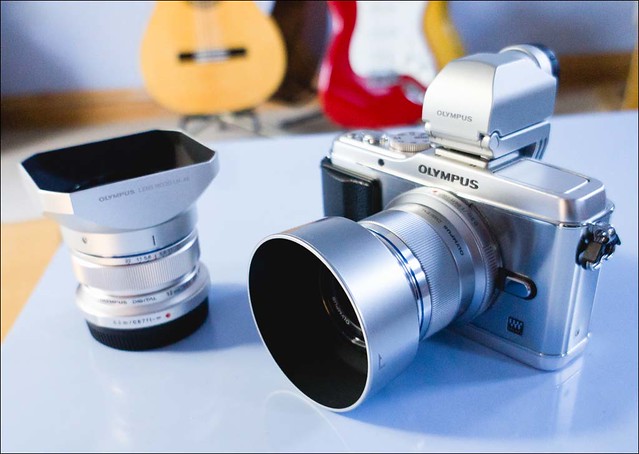
Olympus E-P3 12mm f/2 45mm f/1.8 Lens Hoods

This is the most gorgeous camera outfit I've ever owned. To my eyes it is truly beautiful. If I didn't have to earn my living from photography, this is what I would use. To be honest this is going to be almost impossible to get into a cardboard box and take the post office. Far more difficult to sell than my Leica. I just don't want to sell it. My nephew suggested that I needed something to take pictures of for tests with all the other cameras! So I imagine this outfit will be staying. I don't think I'll use it that much, but everybody needs one indulgence and this is mine.

Thursday, 22 September 2011

"Micro 4/3 is the Big Kahuna"


Basically everything I was planning to write about the Nikon 1 and how m4/3 is the best mirrorless system for me is in this excellent article by Mike Johnson at the Online Photographer. I agree with every word.

Tuesday, 9 August 2011

Here we go again!

"M43:

For Pro's: NO

I think this system has matured in terms of lenses etc. but this is not the system for pro photographer (commercial work). I won't elaborate on this."
 From an internet forum.

There's an incredible arrogance I think, in telling people what they should use. Also in attempting to come up with sweeping statements based on no evidence. I've written often enough in the past, if you make your living from photography, the camera you use is virtually irrelevant. When people pay for photography they are interested in one thing only, the photograph. 99.9% of clients care nothing about what camera or lens you use. The vast majority wouldn't know the difference if you told them anyway.

You may have read these before, but for those who haven't a couple of anecdotes.

David Bailey shot a Vogue cover in the early days of digital, on an Olympus E-10. (3.97 MP) He sent them the file (10.8 MB) They said "We can't publish this, the file is too small" He then printed out the image on an inkjet and sent that to them. They duly scanned and published it.

The editor of Professional UK magazine once did a job for Russian Vogue. During the session he took some shots with a GF1, in addition to a "Pro" Canon. Of the 8 shots printed in the magazine full page 3 were from the GF1.

I have a pretty flexible attitude to cameras. I use "Full-frame" - Leica, APS-C - Nikon and m4/3. I pick whichever I think will be best suited to the job in hand and suited to how I am going to approach it.
If I was to classify my most "lucrative" camera system, it would be m4/3, because I use it the most.

So the question of "m4/3 for Pro's?"

If a "Professional Photographer" can't shoot a front cover, an A3 spread or a billboard Ad campaign on a m4/3 camera, then he probably won't be "professional" for long.

There really isn't any correlation between the size of your camera, the size of your sensor and the size of your income.

The only people who seem to be convinced that m4/3 isn't a "professional" system are "amateurs"

The same people who probably think more about what camera they are seen with, than actually "seeing" some pictures.

I, and many of my colleagues, quite happily shoot fashion, weddings, editorial, portfolio, social and advertising photography on whatever cameras we think appropriate (including m4/3) without giving it a second thought.

We've heard it all before. 10 x 8 is better than Medium-Format, Medium-Format is better than 35mm, 35mm is better than Digital, Full-frame is better than APS-C, APS-C is better than m4/3 ad infinitum.

Personally, I use my eyes to decide how appropriate a camera is for what I need to do with it.
I've never once in this blog told anyone what they should use. I've never once said that if you want to be a "Professional" photographer you should use x rather than y, and I never will.

Photographers who are serious about what they do, wish to be judged by the pictures they take and not by the cameras they use. As "professionals" we know that is the case and that is what will happen.

If we know a camera / lens etc. will do a job for us, then we use it. Of all the photographers I know and have talked with, it's often the "Pro's" who are the flexible / curious / experimental ones and the "Amateurs / Hobbyists / Enthusiasts with aspirations who come up with the dogma and the rigidity. 

The more you rule out, the less opportunity you give yourself to be creative.


Friday, 5 August 2011

Olympus 12mm again - m4/3 thoughts.

Olympus E-PL1 12mm f/2
Olympus E-PL1 12mm f/2 lens

Following on from yesterdays test shots with the E-PL1 I was so impressed with the raw files conversions from the 12mm f/2 lens on the E-PL1 that I took that camera out yesterday and left the E-P3 at home.

Olympus E-PL1 12mm f/2
Olympus E-PL1 12mm f/2 lens 

Once again very impressive results. I wrote in my review of the 12mm lens that I had obtained sharper results on m4/3 with other lenses. I was at the time referring to m-mount lenses. Having the possibility to work with raw file conversions from this lens in Photoshop ACR, now I'm not so sure. I'm hard pressed to think of any other m4/3 compatible lens I've used that is sharper than this.

Olympus E-PL1 12mm f/2
Olympus E-PL1 12mm f/2 lens  Multi-image panoramic stitch.

Olympus E-PL1 12mm f/2
Olympus E-PL1 12mm f/2 lens  Multi-image panoramic stitch.

Olympus E-PL1 12mm f/2
Olympus E-PL1 12mm f/2 lens  Multi-image panoramic stitch.

I have also been using a Voigtlander 75mm f/2.5 Heliar over the past couple of days as my telephoto option, in addition to the 12mm. That gives pretty impressive results too.

Olympus E-PL1 Voigtlander 75mm f/2.5 Heliar
Olympus E-PL1 Voigtlander 75mm f/2.5 Heliar lens  Multi-image panoramic stitch.

In a review of the E-P3 I saw recently, I read this. 

"But the big question is IMAGE QUALITY! How does the E-P3 compare to the other cameras? Well, in all reality it is up there and close but you will still get better overall image quality from the X100, X1, and Ricoh GXR.

Actually I disagree with this. I've owned an X100 and X1 and yes they are pretty impressive. But when I put a top quality lens on a m4/3 camera the results at low ISO's look just as good to me. The Voigtlander I mentioned above, my Zeiss 50mm f/2 T* Planar and yes the 12mm f/2 give me results that I haven't seen bettered. The Olympus 12mm for example looks sharper to me wide open than the Fuji lens on the X100.

Regarding the Ricoh GXR. I looked at some of the samples in the Dpreview article on the m-mount module for the Ricoh GXR. 
Yes, they look nice, but I'm getting results just as good on m4/3 with my quality lenses. Plus I'm getting a lot more versatility. As I indicated yesterday I went out with an AF Olympus lens and a MF m-mount lens. When you think of the possible combinations of lenses I could have gone out with, you begin to see the advantages of m4/3.

Of all the digital cameras I've ever used, and I've used a lot!, the best image quality I've ever obtained comes from a Leica M9. However second to that is m4/3. No matter what other reviews say, no matter what DxO come up with, for my uses i.e low ISO outdoor work, I prefer m4/3 (with good lenses of course) to any other system other than the Leica. That includes Nikon and Canon DSLR's and yes the Fuji X100 and Leica X1. 

This is why I keep using it, and keep coming back to it, no matter what else I use. As I've written before, I've been having eye problems and thought that I would have to stop using cameras with non-optical viewfinders. However I've been able to find a solution. My desire to come up with this solution was, to a large extent, to enable me to use the E-P3 and 12mm. 

While I'm very pleased with the Nikons (Cameras and lenses) I've been using recently, m4/3 is still my preferred option for landscape and location work, when I want to use AF lenses (and often when I'm using MF too) Part of this is because of the lightness and size, but its also about the IQ too. I've often talked about the "glossy" look that I think m4/3 has, and certainly I love the sharpness I get and the colour which I think is superb.

I do take account of the lesser performance at higher ISO's, though that is not much of an issue for me, and the reduced dynamic range, though I do think that is overated, but for my uses m4/3 works very well. The depth-of-field advantages, the weaker AA filters, the absence of dust spots all contribute to the usefulness of the system for me. By combining images I can produce very high resolution files and I've had many of my m4/3 images used for large-scale reproduction, advertising campaigns and all manner of other uses. 

The people who buy my pictures have no problems with it whatsoever. They don't read reviews, look at graphs or debate on internet forums. They just use their eyes. I've had m4/3 shots used as A3 double-page spreads, on the front covers of glossy magazines, and on billboards. I've seen them used on TV programmes, for advertising in magazines, newspapers and on the web. I, and others I know, have used m4/3 for events, weddings, fashion, landscape and almost every other use you can imagine. I'm far from the only professional photographer who uses the system and to imagine we all just use Canon and Nikon DSLR systems is far from the truth.

I actually get quite angry when I see m4/3 described as some kind of amateur, hobbyist system, which is inferior to APS-C. I've never thought that, and the first time I looked at the results from my G1 just a few short years ago, I realised that there was something special here. I still think that, and since buying that G1, m4/3 has, by some distance, been my most used system. 

I wrote yesterday (somewhat light-heartedly) that the Sony NEX-7 (if the specs. are correct) would be all I need. That may be true, but it doesn't mean that I would buy one (though I probably will!) and it certainly doesn't mean that I've got any plans to abandon m4/3. 

Come back in a few years time and I'll probably be writing very similar articles to this.

Tuesday, 14 June 2011

Can m4/3 be used professionally?

In answer to a question on a forum about using m4/3 as a professional, I wrote this:-

"I've used m4/3 professionally ever since it came out. Stock photography, weddings, events and educational and industrial jobs both for stills and video.

One of the important things about earning your living from photography is that you make the decision on what to use based on how well it will get the job done in any given situation.


If m4/3 does the job for you then use it, if not use something else. If people pay you they expect results, and they expect those results to be consistently good, what they are looking for and worth the money they paid you to get them. If you know, and I mean really know, that m4/3 can do that then there's no problem.


As other photographers have pointed out, going back a few years we were using cameras that are nowhere near as good in terms of IQ, speed and usability as current m4/3 cameras. Indeed I was shooting weddings and studio portraits with a Fuji S2 Pro in 2003/4 as were many of my colleagues. A GH2 is a vastly superior camera to that in almost every way.


The most important thing isn't what gear you use but how well you know it and can get the best results from it. You also have to be sure that it can do the job, you can operate it so that it can do the job, its reliable enough to do the job and the results will justify your fee.


If you think it
might do the job then thats not good enough. When I use m4/3 for "pro" jobs I am sure it can handle the demands of those jobs because I've tested, I've used it before etc. If I have a job where I'm unsure if it will do it or not I use something else that I'm 100% sure of. Even then I'll make sure I have backups for everything.

Being professional is more about what's in your head rather than what's in your bag."

Tuesday, 7 June 2011

Olympus E-PL2 Panoramas - Where is m4/3 headed?

Olympus E-PL2 Panasonic 20mm f/1.7

Olympus E-PL2 Panasonic 20mm f/1.7

Olympus E-PL2 Panasonic 20mm f/1.7

Olympus E-PL2 Panasonic 20mm f/1.7


Olympus E-PL2 14-150mm zoom

Where is Micro Four Thirds headed?

With the upcoming GF3, heavily leaked this weekend, Panasonic seem to be slowly coming towards a coherent product line that will provide different models for different kinds of photographers. With a range that includes the GF3, G3 and GH2 there are now cameras that will provide for both point and shoot upgraders and DSLR users wanting to downsize without loosing quality.

Though there are still inconsistencies, such as when you add a kit zoom to a GF3 it suddenly gets a lot bigger (though this doesn't seem to be a problem for the Sony NEX), this does seem to be settling down into a more balanced selection of cameras. Panasonic also seem to be quite ruthless in their determination to succeed with this, with the axing of the only recently released GF2.

From all available information, it seems Olympus may be going the same route too.

So we have a range of cameras, and between the two companies a pretty decent set of lenses. The soon to be released 25mm f/1.4 from Panasonic and the probable? 12mm f/2 from Olympus will add more high quality primes to the collection of (mostly) very capable zooms. Panasonic have also proved that they can get excellent results from a 4/3 16MP sensor.

All of this is good news. When the system first appeared, there were basically several versions of the same camera. In a month or two I suspect we will see much more choice, from the very small and pocketable to the more well-specified, but all retaining the idea of small and light without compromising on image quality.

I don't think anyone as yet is in a position to know where this is going to go next. Panasonic and Olympus no longer have the field to themselves. Sony and Samsung are already taking a slice of the market, and others may be preparing to give it a go as well.

To a large extent this will depend on the answers to some questions.

Can Panasonic push the sensor even higher? Sony are obviously ambitious to get their MP count higher for APS-C, and whether they succeed, we'll see soon. So can Panasonic keep up pro-rata? If Sony do produce the rumoured 24MP APS-C can Panasonic come up with a 20MP 4/3 sensor?

Will cameras like the GF3 and the rumoured Olympus "Mini" make serious inroads into the compact point and shoot market? Will Panasonic / Olympus keep the "enthusiasts" happy with their ever diminishing camera design?

If the answer to these questions is yes, then we may expect a bright future for the system. If no then we may get a marginalised product line similar to what 4/3 has become.

Both the m4/3 companies are now in a very real game of leap-frog with their competitors, and they can surely no longer just go their own way. They have to respond to what other manufacturers bring out. This competition will hopefully push them to better products for us all to enjoy. Ultimately, unless we're shareholders in the companies, we can just select what's best for us from whatever is available, and to a certain extent it may not matter whether the system survives or slowly fades away.

If its m4/3 or APS-C does it really matter?   

Thursday, 26 May 2011

Is this as good as micro four thirds gets? Where does it go from here?

Panasonic GH2 20mm f/1.7

The question "Is this as good as micro four thirds gets?" is not meant in a negative way. The combination of the GH2 sensor and the 20mm and 45mm Panasonic lenses would be most peoples choices for the best quality in both camera and lenses.

Indeed I've certainly found this to be the case. By using top quality m-mount lenses, the Voigtlander 25mm and the Leica D 4/3 lenses, I have been able to get slightly sharper results from the GH2, but in terms of the system itself these two prime lenses give very satisfactory results.

Panasonic GH2 45mm f/2.8

There is however the question of where does it go from here? The GH2 has managed to combined more pixels with better high ISO performance, and I believe its the case that this ratio of MP's to noise will continue to improve. However there is always the question as to whether the choice of the smaller sensor is going ultimately to "loose out" in the long run to the APS-C size used by other manufacturers.

Panasonic GH2 20mm f/1.7
Panasonic GH2 20mm f/1.7  

In terms of what I've used, I see two different comparisons. Neither the Sony NEX or Samsung NX systems have so far proved to me that they are superior to m4/3. I've tried a NEX-5, an NX-10 and NX-100 and none of those cameras have persuaded me to give up my m4/3 cameras and lenses. However the Fuji X100 is a different proposition. The APS-C sensor in this camera produces stunning results. Quite simply, for me, the best non-full frame sensor I've ever used, both in terms of sharpness of results and high ISO performance. 

So while Panasonic and Olympus, look to me to be holding their own against Samsung and Sony (Though the rumoured 24MP sensor for the NEX, may change this significantly) the Fuji has indicated just how good the slightly bigger sensor can be.

Panasonic GH2 45mm f/2.8

So can m4/3 compete with this? Or should they even be trying? There are already indications that Panasonic and Olympus and indeed Sony are competing now in what might be called the "miniturisation market". Ever smaller cameras, trying to attract the lucrative "point and shoot" compact market. Again, only rumours but it seems both Panasonic and Olympus have smaller m4/3 cameras on the verge of being announced. 

However, they face a lot of competition and it could be argued that the particular uniqueness of the system is being lost.

Panasonic GH2 20mm f/1.7
Panasonic GH2 20mm f/1.7  

So have these companies finally decided that the best chance for profit is going down the small camera > upgrade path rather than the DSLR > high quality smaller lighter alternative one?

Personally I hope not. I hope that the E-P2 and GF1 don't become extinct lines. The fuss over the X100 (and it shows no signs of stopping) has indicated a tremendous interest and demand for a camera of this type. 

Though Fuji have obviously been affected by the recent disasters in terms of supply, they also admitted that they vastly underestimated the demand for their camera and hadn't made enough to fulfill pre-orders. Add in to this the fact that Voigtlander also underestimated how many people would want their 25mm f/0.95, and that is constantly in short supply, and the difficulties Leica had in their first year of making enough M9's to satisfy demand.

There is, I believe, a huge market for quality equipment. Smaller than the market for compacts certainly, but how big I guess nobody knows. Its certainly a market that tends to buy more gear and probably spends more money on it. 

I hope that m4/3 doesn't ignore this, to a large extent obviously because I'm part of it!, but also because I believe its an important part of the market. Not just because of its spending power but because its the most vocal, and the most likely to try new things (or in the case of some of the equipment I've mentioned - old things!) Panasonic and Olympus are in a prime position to take advantage of this. 

Its certainly going to be interesting to see what Olympus particularly come up with next. That will, I think, give us a very good idea as to where m4/3 is headed. We can then decide if its for us or not.

Panasonic GH2 45mm f/2.8


Wednesday, 9 February 2011

Vapourgear

M.ZUIKO Concept lens_1

Olympus show mock-up of future lens. 43Rumors -  http://www.43rumors.com/new-m-zuiko-high-end-micro-four-thirds-lens-mockup/


Anyone else think these mock-ups and teasers are getting slightly ridiculous?. It could be 6 months before they announce what this lens is and up to a year before its for sale. Lots of these things end up being different anyway. The infamous Sony mirrorless camera with the stuck-on lens being a good example.

I don't really know what these things are supposed to achieve. Are we expected to put our life on hold while we wait breathlessly for this to appear? 

While all this rumour and speculation is undeniably entertaining, the amount of genuine information - i.e. we're making this and it will be available on such and such a date gets rarer. I'm as fond of a good rumour and a lengthy discussion on its merits as anyone, but this constant stream of "vapourgear" is getting a bit over the top, even for me.

Tuesday, 8 February 2011

Mirrorless Expansion


From Mirrorless Rumors - http://www.mirrorlessrumors.com/zeiss-cosina-voigtlander-sigma-and-tamron-all-do-join-the-sony-nex-system/
In a flurry of activity over the past few days we have seen announcements that Zeiss, Schneider-Kreuznach and Komamura have "joined" micro-thirds in addition to Cosina-Voigtlander. Today Sony have announced that Zeiss, Cosina-Voigtlander, Sigma and Tamron are going to be "joining" the Nex system.


So it looks like we are going to be getting an expansion of what both these systems are able to offer in terms of lenses. Since both Panasonic and Sony have produced video cameras in addition to stills cameras that share the same mounts, some of what is planned is obviously destined for that. The ultra-expensive Zeiss movie lenses being an example. Zeiss is no surprise for the NEX system as they already make lenses for Sony.


The rapidly increasing sales of these compact system cameras is obviously of interest to 3rd. Party lens makers and they see an opportunity for sales and probably also don't wish to be involved in any "boat missing".


What will come out of all this in terms of products, we can only wait and see.
All this a day after Canon seemingly signaled their continuing non-involvement (non-interest?) in anything "mirrorless", with the announcement of the 600D and 1100D.


If nothing else all this should make for some interesting speculative posting over the next few days!


UPDATE.


Sigma are going to make lenses for m4/3 as well as NEX.


From 43 Rumors - http://www.43rumors.com/sigma-announces-they-will-join-micro-four-thirds/

Thursday, 3 February 2011

m4/3 > leica?

Panasonic GH2 Olympus 50mm f2 macro 20mm f1.7

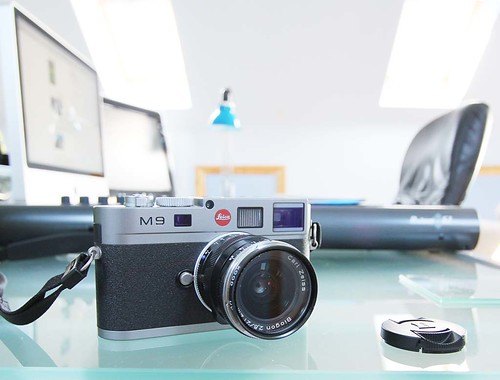
Leica M9 21mm f2.8 Biogon


Here's something I posted.

Without wishing to get into the usual Leica debates about price, value, etc. there are a few factors that contribute to how much they cost. Since this seems to be the basis for much of the criticism that is levelled at the camera and its owners. I too used to be skeptical about the whole Leica idea, and during my film days, despite being in a position to afford one, always stuck with my Nikons. There are Nikon and Canon cameras which cost the same as a Leica but they and their owners seem to attract less criticism. 

Leicas are hand made in Germany. This increases their cost significantly. Also because of the size of the company, its pretty small compared to most camera maunfacturers, they are never going to mass produce either cameras or lenses. The M9 was introduced in September 2009. Its taken until late last year for them to catch up with orders. As a consequence of this there is apparently a shortage of lenses, at least in the UK. Add to this that all cameras and lenses are individually tested before being released and the cost per unit rises again. Also with the M8 and M9 you get an unconditional warranty. For the M8 its 2 years, for the M9 its 1 year. When I had my M8 I dropped it, smashed the screen and the camera didn't work. This was entirely my fault. I returned it to Leica, they rebuilt it and returned what looked like a brand new camera to me, no quibble, no charge. So there was probably not a lot of profit on that camera. 

You are also paying for longevity. Until recently I used a Leica 135mm lens that was manufactured in 1968. It was optically and mechanically perfect, and produced very sharp images with no distortion or CA or fringing. Though there are problems occasionally with cameras and lenses, Leica will usually fix or replace with them under their warranty. They also make it possible, in certain circumstance, to transfer this warranty if you sell the camera or lens. 

Yes they are expensive and I would be very happy for them to lower the prices on their lenses and cameras. But I do realise that I'm buying a product that uses the best materials they can afford, rather than trying to keep costs down at every stage of manufacture.
Whether you think they are worth the price is a question that can only be answered individually. I think my M9 and Leica lenses are worth it, but not everyone may agree. I do however have the advantage of tax concessions as photography is my job, and I also make an income from the pictures I take with, so the real cost to me is somewhat less than others.

I would love m4/3, or indeed any camera system to come up with the same quality that I see from my M9. Try as I might to convince myself that I have found something that equals the sharpness and resolution, I always have to admit that nothing does. It would save me having so much money tied up in the system, would stop me treating the thing like its fragile beyond belief (My unconditional warranty has now run out!) and would probably be easier to use. There's no doubt that often its a PITA to use, and for that reason I do use m4/3 a good deal of the time. Its a much more user friendly system.

I enjoy using m4/3 and I enjoy the results it gives me. In many of the situations I work in, using the Leica would result in lots of missed picture opportunities, and if I could only have one camera and lens I would probably choose the GH2 and 20mm f/1.7 lens. 

Its perfectly valid to say a system is not for me. Its also perfectly valid to say I'd love that but can't afford it. I can't afford many of the Leica lenses I would love to have, and having used Voigtlander and Zeiss I do feel that many Leica optics are seriously overpriced. However I'm not sure its valid to say I can't afford it therefore it must be not worth it / no good anyway / a waste of money / only bought by idiots with too much money / just male jewellery for people to pose with etc. etc. 

Though this thread is refreshingly free of much of that, I have seen such remarks voiced frequently. We can all say what we think, and I will admit to voicing much of the same in the past. However actually using Leica gear changed my mind and I'm prepared to make a few sacrifices in order to own it. Thats my choice and one that I'm happy with.

Thursday, 27 January 2011

m4/3 with Pentax lenses - 2 plus the versatility of m4/3

m4/3 with Pentax lenses - 2


Panasonic GH2 Pentax 70mm f/2.4 limited lens Novoflex Pentax K m4/3 adapter


This is a Panasonic GH2 fitted with a Pentax 70mm f/2.4 limited lens.


Panasonic GH2 Pentax 70mm f/2.4 limited lens Novoflex Pentax K m4/3 adapter


Panasonic GH2 Pentax 70mm f/2.4 limited lens Novoflex Pentax K m4/3 adapter


Really good results from this lens, even wide open. Its the best lens for image quality on my Pentax K-5 and it produced very sharp files on the GH2. Nice bokeh too.


Panasonic GH2 Pentax 70mm f/2.4 limited lens Novoflex Pentax K m4/3 adapter


Panasonic GH2 Pentax 70mm f/2.4 limited lens Novoflex Pentax K m4/3 adapter


Panasonic GH2 Pentax 70mm f/2.4 limited lens Novoflex Pentax K m4/3 adapter


Panasonic GH2 Pentax 70mm f/2.4 limited lens Novoflex Pentax K m4/3 adapter


Panasonic GH2 Pentax 70mm f/2.4 limited lens Novoflex Pentax K m4/3 adapter


So yet another option for m4/3. I now have M-mount, Panasonic & Olympus 4/3 and Pentax lenses that I can use on my Panasonic G series cameras. More than I need however. I had hoped to reduce my gear but ebay is a bit sluggish at the moment, and most of it is still here. I'll probably re-list what I don't want  a bit closer to the Spring. Obviously just after Christmas is not a great time to sell.


The versatility of m4/3


I was thinking yesterday about this when the Fuji X100 samples appeared and disappeared again. I have used a Leica X1, Samsung NX10 and Sony A55 and all of them have gone while I still continue to use m4/3. All the cameras had their virtues but for me didn't have enough of them to persuade me to use them rather than what has become my core system.


The advantage of an APS-C sensor is somewhat overstated as far as I'm concerned. Particularly for someone like me who uses anything higher than ISO 200 very rarely. I also find the handling of m4/3 cameras suits me well in terms of size and weight. The GF1 for example is a small camera but its not that light & it feels very solid in my hand. The GH1 and GH2 are excellent cameras to use in the field and I've really grown to love the GH2's handling. 


I love the idea of the Fuji X100 and there's no doubt that it's a very sexy camera. However the samples I saw yesterday have given me something to think about. Apart from the excellent high ISO performance I saw nothing to get me that excited. Like a lot a people I really want the X100 to produce great results and it still may be capable of that.


Most of all I love the ability of the m4/3 system to accept literally 1000's of lenses. My real enthusiasm for it started when I began using Nikon lenses via an adapter. I got some extraordinary results from my 50mm f/1.1 and 85mm f/1.8 lenses. From there I started using M-Mount lenses, 4/3 lenses and now Pentax lenses. The posts last week where I was writing about using the Zeiss 50mm f/2 Planar and Leica 90mm f/2.5 Summarit-M on the GH2 were an account of a real turning point for me. The results were so impressive and did indeed surprise me with the levels of sharpness and clarity, that I've only ever seen bettered by the Leica M9. 


Panasonic GH2 Voigtlander 25mm f0.95 Nokton


Panasonic GH2 Voigtlander 25mm f0.95 Nokton


Panasonic GH2 Voigtlander 25mm f0.95 Nokton


Also where else would I get to be able to use the Voigtlander 25mm f/0.95 lens, which is rapidly becoming my favourite lens of all time. It seems I'm not alone in this as the first production run has apparently completely sold out across the world.


So no matter what else I try I seem to always be coming back to m4/3. Here in the UK we seem to have embraced it enthusiastically. I gather those of you in the US are encountering the same supply problems with the GH2 as with previous Panasonic items. Figures seem to indicate a lower take up of m4/3 there, though whether this is due to the difficulty of actually buying it or other factors is unclear. 


Its not a system for everyone, as many photographers would find it completely inappropriate for their needs but I think there's no doubt that a lot of the innovative technology created by m4/3 will spin off into other camera systems. The removal of the SLR mirror has possibilities that are only just beginning to be explored.


So whether I try a Fuji X100 remains to be seen. The answer is probably yes as I doubt I'll be able to resist it! Whether it stays long term is another story.


Words - David
Images - David and Ann