
Showing posts with label Leica. Show all posts
Showing posts with label Leica. Show all posts
Monday, 26 September 2011
Saturday, 16 July 2011
Leica lens manufacture - Leica lenses
Video from Leica on lens manufacture.
I have to say the only lens I've ever had that fell apart on me was made by Leica! The aperture ring on a 90mm f/2.5 Summarit-M I had became disengaged. They did repair it free of charge, but even so.
I should have listened to Ken Rockwell - http://www.kenrockwell.com/leica/90mm-f25.htm

This is an old video from Digital Rev on using Leica lenses on m4/3 cameras.
Finally the Ricoh GXR Leica M lens module.

Wednesday, 22 June 2011


Tuesday, 29 March 2011

Saturday, 5 February 2011
Process - Part 1
"The Negative is the score, the print is the performance." - Ansel Adams
Not quite the same in the digital age, but this is very much the idea behind the process I use for creating images. In my case the raw file is the negative and my "print" is the edited, saved and stored file that finds its way onto the websites of picture libraries and hopefully onto the websites and into the magazines and brochures of clients.
Its something we do as photographers these days, combining our instinctive compositional skills "in the field", with our editing and visualisation abilities when we get our digital files home. This is very similar to the way Ansel Adams worked. He developed a system for exposure and development and printed his own work. So in many ways he was working in a similar way to how we work as photographers today. He controlled the whole process from picture taking to print production, so when you see an Ansel Adams picture you know that the end result is almost totally his. Not 100%, as I don't believe he built his own cameras and lenses and manufactured the film, but close enough.
I've put together some photo slideshows to show what my "negatives" are from a typical shoot and then post examples of some of the edited versions that I've created from this raw material. When the images that I decide are worth working with emerge from Photoshop, they can look somewhat different, and though this part of the process is something I enjoy far less than actually taking the pictures, it can be very satisfactory to produce what you have visualised when pressing the shutter. That is still very important to me and I often take a picture and make mental notes of what I want to do with the image.
Here's the first slideshow of pictures I took a few days ago.
All images shot with a Leica M9 and Voigtlander 35mm f/1.4 Classic Lens. These are unaltered out of camera jpgs.
Here are some edited images from that batch.


Images - David and Ann
Not quite the same in the digital age, but this is very much the idea behind the process I use for creating images. In my case the raw file is the negative and my "print" is the edited, saved and stored file that finds its way onto the websites of picture libraries and hopefully onto the websites and into the magazines and brochures of clients.
Its something we do as photographers these days, combining our instinctive compositional skills "in the field", with our editing and visualisation abilities when we get our digital files home. This is very similar to the way Ansel Adams worked. He developed a system for exposure and development and printed his own work. So in many ways he was working in a similar way to how we work as photographers today. He controlled the whole process from picture taking to print production, so when you see an Ansel Adams picture you know that the end result is almost totally his. Not 100%, as I don't believe he built his own cameras and lenses and manufactured the film, but close enough.
I've put together some photo slideshows to show what my "negatives" are from a typical shoot and then post examples of some of the edited versions that I've created from this raw material. When the images that I decide are worth working with emerge from Photoshop, they can look somewhat different, and though this part of the process is something I enjoy far less than actually taking the pictures, it can be very satisfactory to produce what you have visualised when pressing the shutter. That is still very important to me and I often take a picture and make mental notes of what I want to do with the image.
Here's the first slideshow of pictures I took a few days ago.
All images shot with a Leica M9 and Voigtlander 35mm f/1.4 Classic Lens. These are unaltered out of camera jpgs.
Here are some edited images from that batch.
Images - David and Ann
Friday, 4 February 2011
More m4/3 > Leica > m4/3 > Leica etc. Olympus E-5

Following on from yesterdays post - here's another piece from the discussion.
"But...HOW would you describe the difference between the Panasonic GH1 as compared to the Leica M8 or M9?"
"The best way to describe how a Leica M9 file looks is it seems like someones removed a softening filter, or if you're adjusting the dioptre setting on your viewfinder and suddenly it snaps into focus from being just out.
Colours seem to seperate more and it gives an almost 3-D look to a 2-D image. All cameras that have no Anti-Aliasing filter produce the same effect, to a greater or lesser extent. A few years ago I saw some Nikon D3 images taken on a camera which had its AA filter removed, and the result was the same. The images were stunning. Its a simple thing to do, but no-one apart from Leica, Sigma and in the past Kodak seem to have had the courage to do it. Though many Medium-Format digital cameras and backs dispense with AA filters also.
Leica and Kodak have come up with the best solution so far. As a by-product there is also a greater colour intensity. The Sigma Foveon sensor cameras, SD14 etc, are known for it, so were the Kodak Pro 14n and SLR/n cameras and so are the Leicas M9 & M9, though the M8 can produce some odd colours.
I believe, though I have no evidence whatsoever to back this up, that the GH2 has a weaker AA filter than the GH1 and the rest of the m4/3 cameras, because it gives, to my eyes, a sharper file. I've written piece after piece on my blog saying that I couldn't really see the difference between native m4/3 lenses and supposedly better quality M-Mount Leica, Zeiss etc. lenses on m4/3 cameras. Until the GH2 that is.
The Panasonic sensors, all m4/3 cameras use, are very good for colour, and indeed produce images that can rival and in some cases surpass any DSLR at low ISO's but the size of the 4/3 sensor probably rules out any idea that they will bring out a non-AA version. I also doubt that anyone else will either. Thom Hogan the Nikon "guru" is constantly writing pieces trying to convince Nikon to bring out non-AA versions of their cameras but they don't seem inclined to do so. However I believe that Panasonic probably reduce the strength as much as they dare, but are wary, like the majority of camera makers, that low noise high ISO performance is important for many possible buyers of their cameras.
Its always struck me that Canon take a quite agressive attitude to noise reduction, producing files that I and others feel are somewhat soft. The new Sony 16MP sensor in cameras like the Pentax K-5, Nikon D7000 etc. is very good, with great high ISO performance, but it doesn't have the "bite" of something like the M9 at low ISO's.
I'm a great enthusiast for m4/3, I used it from the start and its by far my most used system. The origin of this thread was based on the question, "Anyone here switch to Leica system? And then switch back to m43?" I responded to that because thats what I do every week. Use m4/3, then use a Leica, then m4/3 again. To talk about the two systems in the same way and to use them together, shows the respect I have for what the Panasonic engineers have come up with. This afternoon I was out shooting with my M9 and my GH2 fitted with a Zeiss 50mm M-Mount lens. The difference between the two is now less than it was on other m4/3 cameras, in my opinion, and I'm very pleased with what I'm getting from the GH2. However the M9 still wins my personal resolution battle.
Its not just MP's either. I sold a Nikon D3X to buy the M9. I often blow up my M9 files to the same size as the D3X files, and they look sharper to me, even after interpolation. I don't get that from the GH2, though at their native size the GH2 files are pretty impressive. Remember that for the majority of what I do I'm using the base ISO. In the case of both cameras thats ISO 160. If the majority of my work was indoors in low light, I would use neither, as both cameras aren't particularly good at that.
To see what I'm talking about, you really need to look at some raw files from both cameras. Jpgs don't really tell the whole story of what you can get from a file. I did have some Leica M9 raw files on my blog, but nobody looked at them so I removed them.
If you're interested I could do some more."
As mentioned I took both the M9 and GH2 out yesterday. In many ways it was a "back to the real thing" day. While I enjoyed my spell with the GF2, these are the two cameras that produce the files that get me rushing back to the screen to check them out.

Leica M9 Voigtlander 35mm f/1.4 Classic

Panasonic GH2 Zeiss 50mm f/2 Planar
This was the first time I'd ever taken both these cameras out together. I very rarely carry more than one camera as it always makes me think of Dennis Hopper from Apocalypse Now!

However my version was a little more restrained! I used two small light lenses. The Leica had a Voigtlander 35mm f/1.4 fitted and the GH2 a Zeiss 50mm f/2. The latter is interesting as it gives me the closest Leica type results I can get from m4/3.
The combination produced this amazing fungus shot.

Panasonic GH2 Zeiss 50mm f/2 Planar
A friend on flickr described this as three-dimensional and it does have that look about it.

Leica M9 Voigtlander 35mm f/1.4 Classic

Panasonic GH2 Zeiss 50mm f/2 Planar

Leica M9 Voigtlander 35mm f/1.4 Classic
As I discussed in the Dpreview thread, the Leica M9 still wins in the resolution / sharpness stakes, but with the right lens the GH2 isn't that far behind. I recently had a look at some M8 files I took in 2009. I felt that the results from the GH2 that I'm getting looked better, and indeed sharper than those. In fact its only images from the M9 and D3X that now "beat" the GH2 for low ISO image quality, out of all the cameras I've used. A remarkable achievement for a 4/3 sensor.
If only this sensor had made it to the Olympus E-5. There's a review of that camera over at Dpreview. http://www.dpreview.com/reviews/olympuse5/

There's a couple of paragraphs from that review which probably sums up much of what I feel about the E-5.
"Let's make on thing very clear from the outset: the Olympus E-5 is the best Four Thirds DSLR ever made. It offers a better feature set, better baseline image quality, better ergonomics and better build quality than any previous E-series camera. Although at its heart is a relatively old 12MP CMOS sensor, Olympus has managed to squeeze more resolution out of it than we would have thought possible. Low ISO shots taken in good light are outstandingly detailed, and in these conditions the E-5's AF, metering and WB settings (coupled with a very good JPEG engine) work well together, and make the E-5 a pleasure to shoot with.

There's a couple of paragraphs from that review which probably sums up much of what I feel about the E-5.
"Let's make on thing very clear from the outset: the Olympus E-5 is the best Four Thirds DSLR ever made. It offers a better feature set, better baseline image quality, better ergonomics and better build quality than any previous E-series camera. Although at its heart is a relatively old 12MP CMOS sensor, Olympus has managed to squeeze more resolution out of it than we would have thought possible. Low ISO shots taken in good light are outstandingly detailed, and in these conditions the E-5's AF, metering and WB settings (coupled with a very good JPEG engine) work well together, and make the E-5 a pleasure to shoot with.
There are frustrations though - for one, the E-5 is priced too high. Also, its sensor is relatively noisy, dynamic range is good but not as wide as we'd like, and the maximum continuous shooting rate is relatively slow. The E-5's menu system is a bit fussy, the lack of any meaningful customization in movie mode is frustrating, likewise unpredictable AF in multi-point mode. None of these issues is fatal by itself, but taken as a whole, they add up to a camera which just isn't quite good enough to compete in this market segment, especially given the strength of fresh-faced competitors like the Pentax K-5."
A shame really.
With the GH2 sensor the E-5 could have been a really good camera. There are rumours about Olympus coming up with a "pro" m4/3 camera and "pro" m4/3 lenses, whatever that means. However it seems to me that Panasonic have already beaten them to it in terms of camera specifications with the GH2. Whether Olympus can come up with something that justifies the "pro" tag remains to be seen. Isn't the m4/3 idea the complete antithesis of the "tank-like" construction of much of what is described as "pro" photo gear anyway?
I've always taken the view that if you want reliability then a backup camera or cameras are the best idea. Do you buy one Canon 1DS Mk III or two Canon 5D MK II's? Its roughly the same price. My choice would be the latter option.
Still we shall see what Olympus come up with.
In terms of lenses the rumoured Panasonic 12-50mm f2.8-3.5 and 25mm f1.4 look interesting. Both of these look certain to be announced very soon and the zoom would be pretty high on my shopping list. If the other rumour about a Panasonic battery grip is true, and with the way the GH2 consumes power I hope it is, then Panasonic are moving in the right direction as far as this "pro" is concerned.
I would suggest that before thinking of "pro" bodies and lenses, Olympus need to sort out a decent sensor first and foremost. I would have bought an E-5 if it wasn't for the sensor. No matter how good it is at low ISO 12MP just isn't enough. Neither is its medium and high ISO performance satisfactory. I've said quite a few times that it seems to me the way to see what the excellent 4/3 Olympus lenses are capable of is probably best achieved by buying an adapter and putting them onto a GH2. It seems unfortunate to me that the best sensor that Olympus can come up with to show off their excellent optical performance is the E-5 sensor. I've seen what the Olympus 50mm f/2 lens can do in terms of image quality on the GH2, but the AF is appalling. It would have been nice for Olympus to provide its supporters with the same quality sensor allied to the undoubted handling capabilities of the E-5. Still its not to be and it does seem that the 4/3 range of cameras no longer has priority at Olympus. If by "pro" m4/3 they can come up with a system that allows their wonderful 4/3 lenses to work properly and with a sensor that does them justice then I'd applaud that. My suspicion however is that they will just let 4/3 quietly and slowly ride off into the sunset, leaving a whole lot of unfulfilled promise behind. I hope the E-PL2 is not a sign of things to come, as marginal adjustments to already existing products don't really get my adrenalin pumping. Olympus have a history of being innovators and risk-takers in the camera market, they seem to be coasting in their comfort zone currently and thats disappointing.
Words - David
Images - David and Ann
Thursday, 3 February 2011
m4/3 > leica?

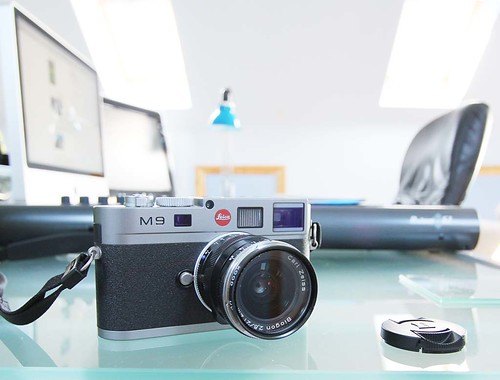
Interesting thread at Dpreview. http://forums.dpreview.com/forums/read.asp?forum=1041&message=37619202
Here's something I posted.
Without wishing to get into the usual Leica debates about price, value, etc. there are a few factors that contribute to how much they cost. Since this seems to be the basis for much of the criticism that is levelled at the camera and its owners. I too used to be skeptical about the whole Leica idea, and during my film days, despite being in a position to afford one, always stuck with my Nikons. There are Nikon and Canon cameras which cost the same as a Leica but they and their owners seem to attract less criticism.
Leicas are hand made in Germany. This increases their cost significantly. Also because of the size of the company, its pretty small compared to most camera maunfacturers, they are never going to mass produce either cameras or lenses. The M9 was introduced in September 2009. Its taken until late last year for them to catch up with orders. As a consequence of this there is apparently a shortage of lenses, at least in the UK. Add to this that all cameras and lenses are individually tested before being released and the cost per unit rises again. Also with the M8 and M9 you get an unconditional warranty. For the M8 its 2 years, for the M9 its 1 year. When I had my M8 I dropped it, smashed the screen and the camera didn't work. This was entirely my fault. I returned it to Leica, they rebuilt it and returned what looked like a brand new camera to me, no quibble, no charge. So there was probably not a lot of profit on that camera.
You are also paying for longevity. Until recently I used a Leica 135mm lens that was manufactured in 1968. It was optically and mechanically perfect, and produced very sharp images with no distortion or CA or fringing. Though there are problems occasionally with cameras and lenses, Leica will usually fix or replace with them under their warranty. They also make it possible, in certain circumstance, to transfer this warranty if you sell the camera or lens.
Yes they are expensive and I would be very happy for them to lower the prices on their lenses and cameras. But I do realise that I'm buying a product that uses the best materials they can afford, rather than trying to keep costs down at every stage of manufacture.
Whether you think they are worth the price is a question that can only be answered individually. I think my M9 and Leica lenses are worth it, but not everyone may agree. I do however have the advantage of tax concessions as photography is my job, and I also make an income from the pictures I take with, so the real cost to me is somewhat less than others.
I would love m4/3, or indeed any camera system to come up with the same quality that I see from my M9. Try as I might to convince myself that I have found something that equals the sharpness and resolution, I always have to admit that nothing does. It would save me having so much money tied up in the system, would stop me treating the thing like its fragile beyond belief (My unconditional warranty has now run out!) and would probably be easier to use. There's no doubt that often its a PITA to use, and for that reason I do use m4/3 a good deal of the time. Its a much more user friendly system.
I enjoy using m4/3 and I enjoy the results it gives me. In many of the situations I work in, using the Leica would result in lots of missed picture opportunities, and if I could only have one camera and lens I would probably choose the GH2 and 20mm f/1.7 lens.
Its perfectly valid to say a system is not for me. Its also perfectly valid to say I'd love that but can't afford it. I can't afford many of the Leica lenses I would love to have, and having used Voigtlander and Zeiss I do feel that many Leica optics are seriously overpriced. However I'm not sure its valid to say I can't afford it therefore it must be not worth it / no good anyway / a waste of money / only bought by idiots with too much money / just male jewellery for people to pose with etc. etc.
Though this thread is refreshingly free of much of that, I have seen such remarks voiced frequently. We can all say what we think, and I will admit to voicing much of the same in the past. However actually using Leica gear changed my mind and I'm prepared to make a few sacrifices in order to own it. Thats my choice and one that I'm happy with.
Friday, 14 January 2011
Leica M9 - The Medium Format Alternative

The weather has been dull and wet for the past few days, and I've been using the time to do more editing of the huge backlog of 2010 images I still have awaiting upload to stock / library sites. Amongst these are a large number of multi-image panoramic shots from my Leica M9. In terms of resolution and image quality, these are pretty jaw-dropping. Beautiful colour and extraordinary sharpness, even after all the warping and bending that occurs when Photoshop or PTGui stitches these together.

I've looked at lots of samples from the Pentax 645D and the large multi-image files created from the Leica M9 have a lot more "punch" than the medium format files. Obviously the Pentax has extremely high resolution for single shots, but for landscape images with the time to be able to take more than one shot the Leica is hard to beat. One of my (slightly late) new years resolutions is to use it more this year.


David
Saturday, 4 December 2010
Remember summer? - Pentax 645D
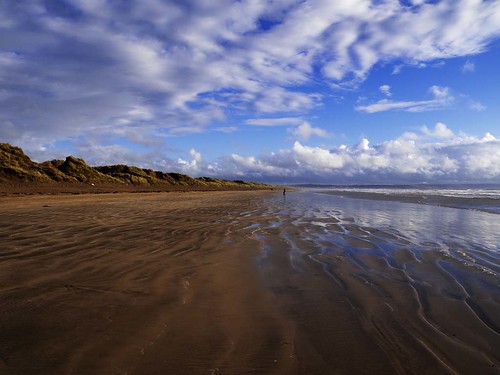

Having heard on the news last night that this cold weather may last until the new year here in the UK, I felt the need to post a couple of shots from last summer.
Both shots - Panasonic GH1 - Leica Panasonic 14-150mm Vario-Elmar

Dpreview have just posted some sample images from the Pentax 645D medium format digital camera, including some .DNG raw files available for download.
The resolution is obviously incredible and you can crop massively into the files and still produce large detailed images. However I was somewhat unimpressed by the look of the files. I remember the biting sharpness and contrast of the Velvia transparencies I took on my film Pentax 645, and I think I was expecting a digital version of that. These samples are a little disappointing however, slightly soft and a bit "flat".
Not unexpected however as Pentax seem to take a pretty conservative view about their sensors. Every one of their digital cameras I've used has been like this. The 645D is being touted as a great camera for landscape photographers, and indeed the film version was just that. However a 3 image stitch from a Leica M9 would equal the 645D's resolution and seriously embarrass it in terms of sharpness, colour and contrast if these samples are typical.
Its nice to be able to say that a Leica is a "cheaper" alternative to another camera.
In an extremely unscientific test I blew up a Leica M9 file to the same size as a Pentax 645D one (148%) and took a 600x600 pixel chunk out of each.

This is the result.

This is the result.

I am aware of exactly how flawed this is but my reaction to all the 645D samples I've seen has been the same. "Shouldn't they be better?" Compared to what I've seen from Hassleblad MF and indeed the Leica S2 they do look soft to me. Anyway have a look for yourself, and see what you think.
Sunday, 31 October 2010
Panasonic and Leica

If somebody had said to me a few years ago that in late 2010 I would be using Panasonic cameras and lenses and eagerly awaiting their latest release I would not have believed them. A microwave or TV perhaps, but a Camera?!!
So why am I now looking to a Japanese electronics giant for innovation, quality and usability in my equipment needs, rather than to the places I looked before, Nikon, Pentax & Canon?
In the article by Michael Reichmann on the Panasonic GH2 there are some interesting quotes.
"At Photokina in 2006 I had dinner with a senior executive in the photographic industry. We were talking about the historical market battle between Nikon and Canon. At one point he paused and said, "You know – the future doesn't belong to either of those two. The future of the photographic industry belongs to Sony and Panasonic. They get it. As far as I can tell, neither Canon nor Nikon do. They're simply putting higher resolution and cleaner sensors in the same old boring cameras. That's not just what the future of this industry is about. Wait – you'll see".
"But, for anyone that's been seriously involved with photography for more than a couple of years, it finally dawns that now, more than a decade into the digital revolution, the differences that we saw – first between film and digital – and now between similarly specs brands, is often de minimus. This means that to make sense of our buying decisions we need to also include haptics and ergonomics. A camera that produces great image quality is desirable, but one that fights you every step of the way with poorly conceived controls and awkward user interface eventually just becomes a pain in the ass. If one is a Sunday photographer, then a lot of design faults can either be overlooked or can be lived with. But for the more serious photographer, and especially working pros and others who use their cameras daily to earn some or all of their living, bad designs simply can't be tolerated.
Which brings us to the Panasonic GH2 specifically, and the G series in particular. Unlike some of its competitors, Panasonic "gets" user interface from a photographer's perspective."
"At the risk of repeating myself, this is a photographer's camera. By this I mean that it was clearly designed by people who use cameras and understand their role as tools, not just by marketing and engineering types looking to win the spec and shelf appeal wars, even if it means that the camera's design is a dog's breakfast of poorly designed menus and awkwardly place controls."
There's nothing I would disagree with in any of that.

On the 24th July 2001 there was an interesting announcement. Panasonic and Leica had joined forces to produce digital cameras. There was a phrase in the press announcement that said "Panasonic, is a minor player in the digital camera market"
As we know this relationship went on to produce compact small sensor cameras, until Panasonic dipped their toes into the DSLR world with two "odd" cameras. First came the L1, and its Leica counterpart, the Digilux3. This was a retro styled brick of a camera that bore little similarity to the rest of the market. It had its charms but was not a big seller. Panasonic had chosen the 4/3 standard for its sensor, allowing the use of Olympus and other lenses on its product. The next camera was the L10, much more a conventional looking DSLR, but with little innovations such as an articulated screen. Again it wasn't a huge seller.
In addition to the cameras, Panasonic, in conjunction with Leica, produced a small (4) lens range. Two kit lenses for the L series cameras, a superzoom and a fast "standard" lens. Those who read here will know my enthusiasm for these lenses. I really don't know who made the decision to make these lenses to such a high standard, but the result was four of the best digital camera lenses ever made. No compromise in terms of quality, or size, weight and price either!! This decision made the camera / lens combinations very expensive, but also established Panasonic as a photographic company to be taken seriously.
It wouldn't have taken a overpaid business guru to come up with the realisation that their 4/3 excursions with Leica weren't going to make Panasonic a fortune, so a rethink was obviously necessary. From this we got m4/3.
Are the quotes from Michael Reichmann's article and the above connected? Not being a member of Panasonics inner sanctum, I can of course only speculate. But if as a "minor player in the digital market" you choose to enter into a partnership with probably the most respected camera company in the world, then this either shows serious intent or divine providence.
The Panasonic relationship with Leica is still going, but only on the compact camera front, and now Leica with the X1 are moving into that area themselves.
To me it looks like Panasonic have benefited from their association with Leica. I agree with Michael Reichmann that the Panasonic G series are cameras for photographers. Much as I love my E-P2 as an aesthetic object, my GH1 is a much easier camera to use, well thought-out and designed to take pictures, rather than look good. Whether I'm overstating the Leica influence, who knows, but I've never believed in co-incidence much.

Yesterday I went out with my GH1 fitted with the Leica D 14-50mm Vario-Elmar f3.8-5.6. This is the kit lens for the Panasonic L10. You'll be familiar by now with my rave reviews of these lenses and this is no exception. This is the slower, lighter and smaller (though marginally) 4/3 zoom of the three that Panasonic and Leica produced. However it may well be the best. In combination with the GH1 sensor the results were simply breathtaking. I've gone on (and on and on!) about the 14-150mm but I think the 14-50mm may be better. The results at 50mm are a whisker away from what I'm getting with the Olympus 50mm f/2 macro. I can still see a slight difference, but its very close.

Panasonic used a scaled down L10 body design for m4/3 but came up with a different kit zoom, the 14-45mm. They would have done this for reasons of economy, size, weight and price. So there are now 2 orphaned cameras and 4 orphaned lenses languishing in the somewhat shrinking world of 4/3. Before they disappear from sight I'm planning to do a bit of small-scale collecting and have both cameras and all four lenses. The lenses will of course get used with my m4/3 cameras. They are chunky, bulky, unremarkable looking pieces of plastic and glass but they produce the some of the sharpest images I've ever seen, and to own all four may not be what I need but thats never stopped me before!
D
Saturday, 16 October 2010
Voigtlander 75mm f/1.8 Classic Heliar on Leica M9
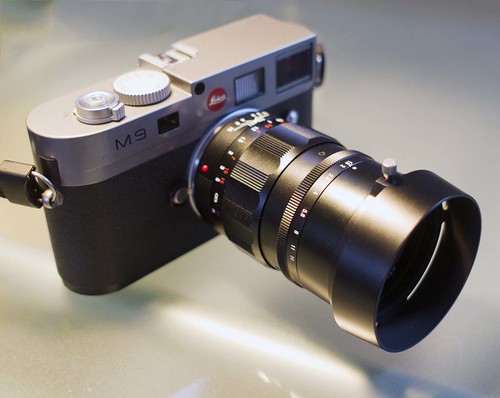
FIRST IMPRESSIONS.
Build
The first thing to say is that this is a beautifully made lens. Voigtlanders are well put together generally but this one is especially good. Lovely smooth focus ring and aperture click stops. It feels substantial but not over heavy. Its a thin design and medium long.
Specs.
Smallest Aperture: F16
Lens Construction: 3 Groups, 6 Elements
Aperture Blades: 10
Nearest Distance: 0.9m
Diameter: 57.9mm
Length: 73.8mm
Weight: 427g
Filter size: 52mm
Hood: Included
Colour: Black
As is common with many m-mount lenses it doesn't focus that closely. It has a handy 52mm filter size and there's a hood included.
Whats it like wide-open?
Always the first question with a fast lens.
The following are at f/1.8.
(N.B. Ignore exif data as I've used a manual preset on the M9. The nearest was a 75mm f/2. f2 in the exif data is f1.8 on the lens)


I'm pretty impressed with the wide-open performance. The sharpness doesn't match what it does at f/4 onwards, which is produce excellent results, but its really very good. There's also virtually no CA or fringing on my copy which is good to see. I had one of the 75mm f/2.5 Colour Heliars and that was quite unpleasant wide open with lots of purple fringing. This new lens is much better than that and produces very "clean" results at f/1.8.
Overall image quality.
The lens works very well the M9 and for this first run out with it I was mostly using it either wide open or up to f5.6 only. Very impressive at f/5.6 and very good at f/2.8 and f/4. It performs in a similar fashion to other Voigtlanders I've used. Great sharpness with a real "bite" to the images and with nice, but not great, bokeh.


I'm going to work with it over the next few days and try it in a variety of situations, but my first impressions are very positive. I was surprised by how good the performance at f/1.8 was and certainly better than I was expecting. I will be using it on my M9 and on my m4/3 cameras for stills and video, where it turns into a very handy 150mm f/1.8 FF equivalent. I was also impressed by the build quality which is really very good indeed and is the best Voigtlander I've used in terms of that.
I've always liked these Cosina Voigtlanders and haven't been disappointed by one yet. The nearest Leica lens I can offer a comparison with is a Summarit-M 90mm f/2.5 which I have. The Voigtlander 75mm f1.8 is easily on a par with that lens in terms of sharpness.
Its a well-made, fast, relatively cheap (for an m-mount) lens and is capable of beautiful, detailed images with the M9. There's not really a lot more to say, except that I'm off to take more pictures with it.

D
Monday, 11 October 2010
The Zoom that breaks the rules

Because I like to write about a variety of cameras and lenses here, what won't be apparent is that for the majority of times that I go out to take pictures I have been using the same camera and lens combination. Ever since I bought the Leica D Vario-Elmar 14-150mm f/3.5-5.6 Asph. OIS its been my lens of choice, usually paired with a Panasonic GH1, with which it works very well. I do use it occasionally with my Olympus E-P2, but I find the GH1 produces slightly better results in terms of sharpness and control over CA and fringing.

For those interested in technical data, there's an old review of it at:-
As the review indicates, it is made in small quantities, and whether its even being manufactured any more is open to question. Made originally for Panasonics foray into 4/3, which didn't last long, it was part of a very small lens range for these cameras that Panasonic developed with Leica.
In addition to the 14-150mm there are three others. The Panasonic 14-50mm f2.8-3.5 Leica D Vario Elmarit, and the Panasonic 25mm f1.4 Leica D Summilux both of which I have owned and are superb. There is also a Panasonic 14-50mm f3.8-5.6 Leica D Vario-Elmar, which I must admit I know virtually nothing about.

Since Panasonic and 4/3 have come to a dead end because of the development of m4/3, these excellent lenses are somewhat stranded. They can obviously be used on Olympus 4/3 camera bodies and on m4/3 via an adapter. There are however some problems. The Panasonic 14-50mm f2.8-3.5 Leica D Vario Elmarit, which is the oldest lens in the range, having been part of the L1 / Digilux 3 kits doesn't AF on the Panasonic G series cameras. Its not compatible with the contrast AF system. It does however AF on the Olympus Pens.
In terms of quality its as good as the 14-150mm, but Panasonic don't seem to either want to or be able to issue a firmware update that makes it AF on their m4/3 cameras. If you are prepared to put up with MF then it can be used on the G series cameras.
The Panasonic 25mm f1.4 Leica D Summilux is a beast. Its huge, and almost as heavy as the 14-150mm. I used one and liked it very much, but then Panasonic brought out the 20mm f/1.7 and I much preferred that in terms of size and useability.

None of these 4/3 lenses are particularly fast in terms of AF and the 14-150mm is no exception. However its not particularly sluggish either and is generally faster than its given credit for. Its nowhere near the performance of the Lumix 14-140mm lens or the Olympus 14-150mm M.Zuiko but both those lenses, while decent performers, are some way off the Vario-Elmar in terms of sharpness.

I've used superzooms from Nikon, Canon, Sigma, Tamron, Panasonic and Olympus in the past and none of them come close to the Vario-Elmar. I've written before about how its like having a series of prime lenses. Its not 100% perfect as the review above indicates, but probably the closest thats available currently. Superzooms are supposed to be compromises and be about convenience over ultimate quality. The 14-150mm Vario-Elmar tears up the rule book in this regard being both convenient and super high quality.

I get the same image quality from it as I do from my 20mm f/1.7 or my m-mount lenses. I can get this without having to change lenses or manually focus. While its not the smallest or lightest lens (Its 535g) it does eliminate the need for me to carry anything else. I do occasionally take out additional lenses, but most of the time just carry this fitted to my GH1. This gives a combined weight of around 900g. When you consider that a Canon 7D body only is virtually the same weight , it gives me an incredibly versatile outfit that I can carry for hours at a time.

One of the reasons I am waiting impatiently for the GH2 is to be able to use this lens on it. If its as good a camera as I'm hoping it will be then combined with the 14-150mm it could / should? produce superb results, and to a large extent take care of the majority of my needs. There are many occasions when AF is a great help, and much as I love using my M9 and the results it gives, I tend to use it mostly on trips when I will have the time to work with it. I also love the convenience and ease of one camera and one zoom lens and feel the GH1/14-150mm combination gives me the best options to gear ratio. I use it particularly when I'm exploring new terrain and have no idea of what to expect. Having that wide-angle to telephoto range in one lens means that I can quickly move between the two. I find this very useful in changing light. Those who photograph in the UK are well aware of days when the sun hides behind the clouds most of the day and only occasionally appears, usually to dramatic effect. Sometimes you have to work very quickly and thats when a one-zoom outfit proves its worth.

It is without doubt my most useful lens and the one that I use the most and I can see myself using it for the foreseeable future. I can't really see where a rival to it is going to come from.


Words - D
Images - D & A
Subscribe to:
Posts (Atom)